

The Commercial Real Estate Guide to Future-Proof Connectivity
Picture this: A major enterprise signs a lease in your state-of-the-art, LEED-certified commercial tower. The mobile operators promise blazing-fast 5G speeds, but the moment your new tenants walk through the lobby doors, their smartphones drop back to 4G—or worse, lose service entirely.
The promise of 5G is transformative: lightning-fast downloads, zero lag, and the capacity to run thousands of smart building sensors simultaneously. But the reality is that 5G has a massive weakness when it comes to commercial real estate.
If you want to understand how to actually make 5G work inside your property, you do not need an engineering degree. Here is the straightforward, business-focused breakdown of how indoor 5G works and how to turn it into a commercial asset.
The Problem: Why 5G Hates Your Building
To understand how to fix 5G indoors, you have to understand how it travels.
Think of a 5G signal like a high-performance sports car: it is incredibly fast on an open, straight highway, but it cannot handle speed bumps. 5G operates on much higher frequencies than older 3G or 4G networks. Because these frequencies are so high, they are notoriously fragile and have a very difficult time penetrating solid objects.
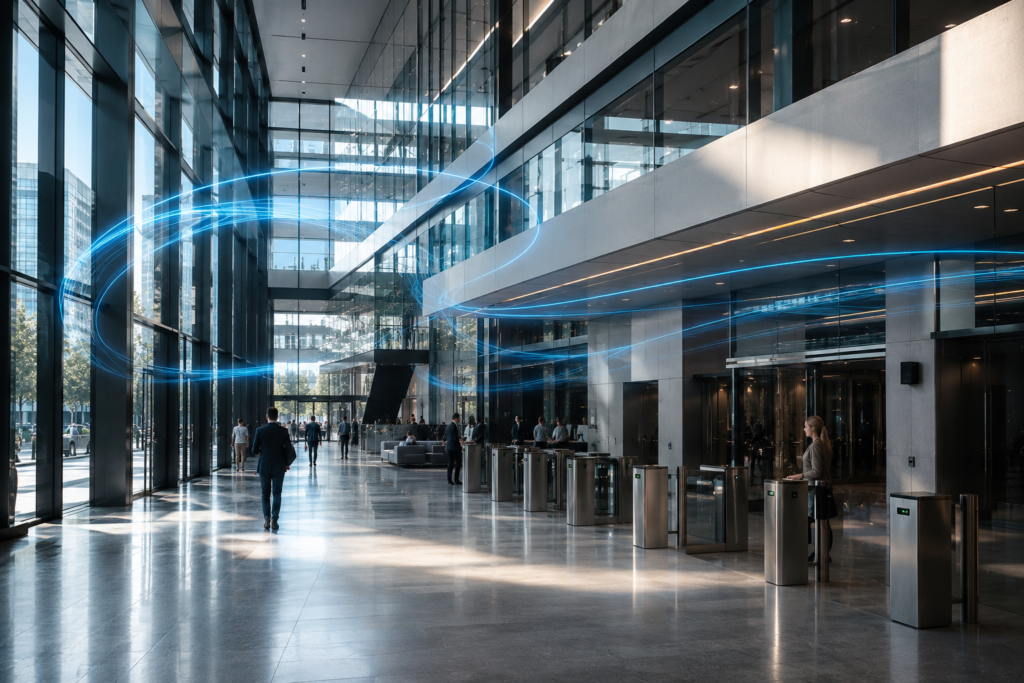
Combine this “fragile” signal with modern, eco-friendly architecture. To hit your ESG (Environmental, Social, and Governance) targets, your building uses dense concrete, reinforced steel, and Low-E (low-emissivity) energy-efficient glass. These materials create an invisible shield that aggressively blocks outside mobile signals.
When you combine a fragile 5G signal with an impenetrable green building, the result is a total cellular dead zone.
The Solution: A Digital 5G “Plumbing System”
You cannot rely on the 5G cell tower down the street to penetrate your walls. To make 5G work indoors, you have to bring the signal inside and distribute it yourself. The gold standard for doing this is a Digital Distributed Antenna System (DAS).
A digital DAS acts as high-tech plumbing for your building’s digital infrastructure. Here is how a state-of-the-art system handles massive 5G capacity:
- The Brain (Master Units): Equipment like the Orion master unit is placed in your IT room and connects directly to the mobile operators’ networks. Instead of trying to push a fragile radio signal through your building, it captures the 5G signal and converts it into pure, high-speed digital data.
- The Massive Pipes (Fiber Optics): 5G requires massive amounts of data capacity. Modern digital DAS uses industry-standard digital fiber-optic connections (like QSFP+) to carry this data. These digital “pipes” are so robust they can handle up to 1200 MHz of radio frequency bandwidth simultaneously, moving the data perfectly without any drop in speed or quality.
- The Sprinklers (Remote Units): Compact nodes, such as the Stratus remote units, are installed discreetly in ceilings throughout your property. They take that flawless digital data, convert it back into a 5G signal, and broadcast it seamlessly to the users below.
Why Analog Fails and Digital Wins
Older analog systems act like leaky pipes; the further the signal travels, the more static and distortion you get. Analog simply cannot handle the immense data loads of 5G.
A digital DAS is completely software-defined. When operators roll out new 5G features (referred to as NR, or New Radio), property managers can configure these parameters directly via software. You can shift capacity to different floors or upgrade the network remotely, without ever ripping open your beautiful ceilings to replace hardware.
The Four Pillars of 5G ROI
Investing in indoor 5G infrastructure is a strategic business move that adds measurable value to your real estate portfolio:
- Premium Tenant Satisfaction: Today’s tenants run their businesses from the cloud. A 5G-ready digital DAS ensures flawless video calls, instantaneous file sharing, and zero frustration, directly driving lease renewals.
- Future-Proofed Property Valuation: A building equipped with a digital DAS is a premium asset. It is built to effortlessly handle the future demands of IoT (Internet of Things) devices, automated security, and smart building sensors.
- Critical Safety and Security: While your tenants enjoy 5G, the exact same digital infrastructure safely routes critical emergency radio bands to first responders in stairwells and basements.
- ESG Synergy: You do not have to choose between sustainability and connectivity. Digital DAS hardware is incredibly energy-efficient and compact, allowing you to bypass the signal-blocking effects of eco-friendly glass without sacrificing your green certifications.
Don’t let legacy technology bottleneck your smart building. By investing in a digital infrastructure designed for 5G, you transform poor indoor coverage from a daily tenant complaint into a powerful, value-driving asset.
Are you currently facing pressure from tenants to provide better 5G speeds, or are you trying to future-proof a brand-new property currently in the design phase?