

Which is Right for Your Smart Building?
If you are a commercial property owner, architect, or facility manager, you already know that poor indoor mobile coverage is a major commercial liability. When researching how to bring 5G and seamless connectivity into your building, you will inevitably be asked to choose between an Active DAS and a Passive DAS.
If you ask an engineer to explain the difference, you will likely get a 30-minute lecture on radio frequencies, power loss, and decibels. But as a business leader, you only need to know one thing: How will this impact my tenants, my building’s value, and my bottom line?
Here is the straightforward, business-focused breakdown of Active vs. Passive Distributed Antenna Systems (DAS) and how to choose the right digital infrastructure for your property.
The Root of the Problem: Why You Need a DAS
Modern buildings are built with sustainable, eco-friendly materials like Low-E glass, dense concrete, and steel. While these are fantastic for your ESG goals, they act as an invisible shield that completely blocks cellular signals from entering your property.
To bypass this shield, you need a Distributed Antenna System (DAS) to bring the signal inside and distribute it. But how you distribute it makes all the difference.
Passive DAS: The “Leaky Garden Hose”
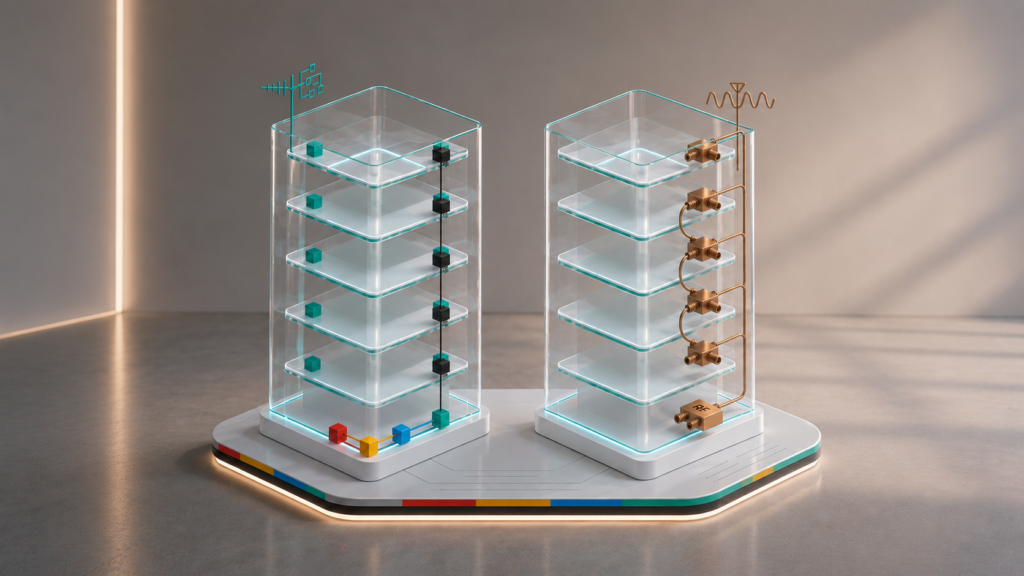
A Passive DAS is an older, legacy approach to indoor connectivity. In this system, the cellular signal is pushed through heavy, traditional copper wiring and split out to different antennas. It relies entirely on the raw power of the original signal source.
The Business Impact:
Think of a passive system like a leaky garden hose. The further the water (the signal) has to travel, and the more times you split the hose to go to different rooms, the weaker the water pressure becomes.
- Signal Degradation: In an analog, passive setup, noise and distortion are added the further the signal travels, and the loss through the cables directly results in a weaker signal for your tenants.
- Lack of Flexibility: There is no selectivity to prevent unwanted signals from interfering, and you cannot easily adjust power levels for different operators.
- The Verdict: A passive DAS might be an acceptable, low-cost fix for a very small coffee shop or a single basement level, but it completely fails to deliver the premium experience required in large commercial spaces, hospitals, or high-rises.
Active (Digital) DAS: The “Smart Digital Network”
An Active DAS (specifically a modern Digital DAS) is the gold standard for today’s smart buildings. Instead of relying on heavy copper, an active system captures the mobile signal at a central hub, converts it into pure digital data, and distributes it over high-speed fiber-optic cables. The signal is then converted back to a perfect cellular connection by powered units placed discreetly in your ceilings.
The Business Impact: Because the signal is digitized, it is transmitted perfectly to the far ends of your building without any loss in quality.
- Perfect Signal Everywhere: End-to-end performance is guaranteed and completely independent of how long the fiber cables are. A video call on the 40th floor will be just as crystal clear as one in the lobby.
- Software-Defined Agility: A digital DAS splits operator signals into individual data streams that can be separately controlled. If a new tenant needs dedicated 5G capacity, you can adjust the system remotely via software rather than ripping open the drywall to replace cables.
The ROI of Choosing a Digital Active DAS
When you treat connectivity as a critical utility, investing in a modern, active digital infrastructure pays dividends across four key pillars:
- Premium Tenant Satisfaction: Your tenants expect absolute seamlessness. Active digital systems ensure that their smartphones, cloud apps, and smart devices work flawlessly anywhere on the property.
- Future-Proofed Property Value: A digital DAS is inherently 5G-ready. Because it is software-defined and uses high-capacity fiber optics, your building is prepared for the digital demands of the next decade, making it a highly attractive premium asset.
- Critical Safety and Security: First responders need guaranteed communication during an emergency. An active DAS actively filters out unwanted interference and ensures that emergency life-safety networks have the precise power and clarity they need to function.
- ESG Synergy: Active digital systems harmonize with green building initiatives. By using lightweight fiber optics and highly efficient hardware, they require a fraction of the physical footprint of legacy analog equipment, while successfully bypassing the signal-blocking effects of eco-friendly glass and concrete.
Don’t let legacy technology bottleneck your smart building. By choosing an active, digital infrastructure, you transform poor indoor coverage from a daily tenant complaint into a powerful, value-driving asset.
Are you currently evaluating connectivity options for a new development, or are you looking to upgrade an existing property that is struggling with dead zones?