

A Non-Technical Guide for Real Estate Leaders
If you manage, design, or own commercial real estate, you have likely heard the acronym “DAS” thrown around when discussing poor indoor mobile reception. Engineers love to talk about RF design, link budgets, and head-ends, which can quickly make the topic feel overwhelmingly complex.
But here is the truth: you do not need an engineering degree to understand how a Distributed Antenna System works. You just need to think of it as digital plumbing for your building’s connectivity.
Here is a straightforward, business-focused breakdown of how a DAS works and why it is the ultimate solution for transforming dead zones into seamlessly connected spaces.
The Core Concept: The “Digital Plumbing” Analogy
Modern energy-efficient buildings are built with Low-E glass, dense concrete, and steel. These materials are fantastic for your ESG and sustainability goals, but they act as an invisible shield that blocks cellular signals from entering the building.
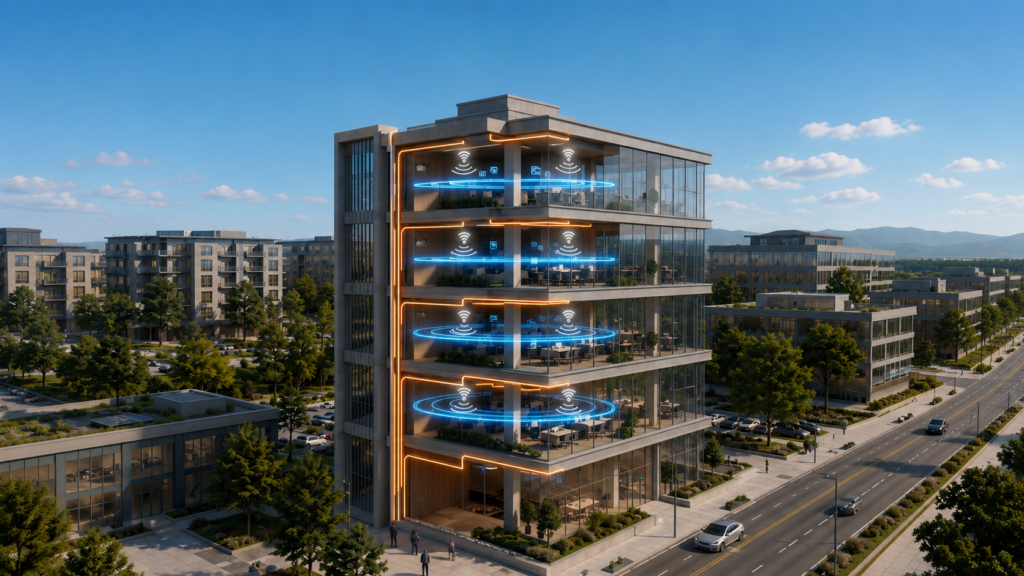
A Distributed Antenna System bypasses this shield by bringing the mobile signal inside and distributing it evenly across your property.
Here is how a state-of-the-art digital DAS, like the Maven Wireless system, accomplishes this in three simple steps:
1. The Brain (The Master Unit)
Think of this as the main water valve connecting your building to the city’s supply. The “Master Unit” (often called an Orion or Cirrus unit) sits in your IT room and connects directly to the mobile operators’ base stations. Its job is to capture the external radio frequencies and convert them into pure, high-speed digital data.
2. The Invisible Pipes (Fiber Optics)
Instead of copper pipes, a modern DAS uses industry-standard digital fiber-optic cables to move the signal throughout the building. Because the signal was digitized by the Master Unit, it travels perfectly over these cables without losing any quality, regardless of how large or tall your property is.
3. The Sprinklers (The Remote Units)
Discreetly placed in the ceilings of your lobbies, hallways, basements, and offices are “Remote Units” (like the Stratus or Cumulus nodes). These units act like sprinkler heads. They take the digital data from the fiber cables, convert it back into a cellular signal, and broadcast it seamlessly to your tenants’ smartphones and laptops.
Why Digital DAS Changes the Game
If you have encountered older DAS installations, they were likely analog systems. Analog systems are essentially like old landline telephones; the further the signal travels through the cables, the more static, noise, and distortion you get.
Modern infrastructure uses Digital DAS. By digitizing the signal, you unlock incredible commercial benefits:
- Perfect Signal Quality: The digital signal entering the fiber is transmitted flawlessly to every remote unit, meaning a video call in the basement is just as clear as one in the penthouse.
- Software-Defined Flexibility: Want to allocate more 5G capacity to a newly leased trading floor? In a digital DAS, capacity and coverage can be adjusted remotely via software, without tearing open ceilings to install new hardware.
The Business Value: Why It Matters to Your Bottom Line
Understanding how a DAS works is only half the equation; understanding why it matters is what drives property value.
- Guaranteed Tenant Satisfaction: Symmetrical, high-speed connectivity means no more dropped calls in the elevator or dead zones in the conference room. It is digital infrastructure that works invisibly and flawlessly.
- Future-Proofed Asset Value: A digital DAS is inherently 5G-ready. As operators roll out new technologies, your building is already equipped to handle massive data capacities, making it a highly attractive premium asset.
- Critical Life Safety: A functioning DAS ensures that emergency response teams have crystal-clear radio communication anywhere in the building, ensuring compliance and peace of mind.
- True ESG Synergy: Digital systems utilize compact, energy-efficient hardware. You maintain your green building certifications while overcoming the signal-blocking nature of sustainable construction materials.
When you treat connectivity as a foundational utility—just like electricity or HVAC—a Distributed Antenna System stops being a complex technical purchase and becomes a clear, value-driving asset.
What is the biggest connectivity complaint you are currently hearing from your tenants? Contact us at Maven Wireless and we can solve your connectivity issues.